

There are two young fish swimming along who happen to meet an older fish. The older fish nods at them and says, “Morning boys. How’s the water?”
The two young fish swim on for a bit and then eventually one of them looks over at the other and asks, “What the hell is water?”
The most obvious, important realities are often the ones that are hardest to see and talk about.
– David Foster Wallace, American writer (1962-2008)
The Water We Swim In
One of the most obvious, important realities in the construction industry today—and yes, one that can be hard to talk about—is that different cultures are present on the job site.
If this seems trivial, it isn’t. Different cultures develop trust differently. And a leader who can’t build trust is going to struggle to find followers.
In Good to Excelente cultural intelligence workshops with executive leaders and project teams, the most common response I get to this idea is curious confusion:
“Yeah? Hmmm. Never really thought about it before.”
When I ask teams to name the most important attribute of strong relationships, “trust” comes up almost immediately. And I agree.
Here’s the catch: while Anglo leaders recognize how critical trust is, very few have intentionally cultivated leadership skills that resonate with Hispanic workers on site.
Doing this is simple, but not easy.
It requires three things:
1. A clear mental model.
2. Better time management.
3. Patience.
Mental Model: The Trust Continuum
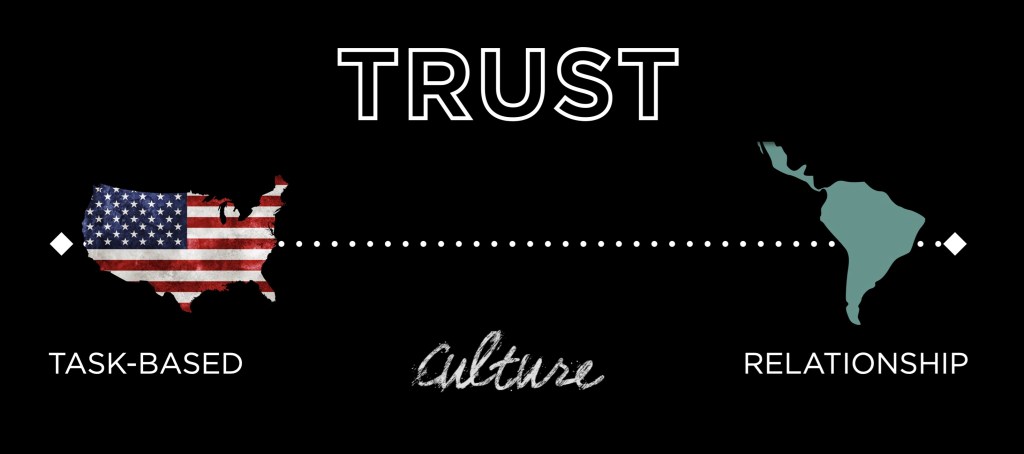
Think of trust as a continuum.
On one end is Task-Based Trust.
Erin Meyer, in The Culture Map, defines it like this:
Trust is built through business-related activities. Work relationships are built and dropped easily, based on the practicality of the situation. You do good work consistently, you’re reliable, I enjoy working with you—I trust you.
On the other end is Relationship-Based Trust:
Trust is built through sharing meals, evening drinks, and visits over coffee. Work relationships build slowly over time. I’ve seen who you are, shared personal time with you, and know others who trust you—I trust you.
Most American leaders—especially on a job site where “time is money” and “schedule is king”—default to task-based trust.
One 50-year-old superintendent put it like this:
“Man, I don’t have time for new friends on the job. Do your job well enough for long enough, and maybe we’ll grab a beer sometime.”
That’s task-based trust.
Prove yourself through performance first; relationships may follow.
By contrast, many Hispanics build trust through relationships. The thought process is more like:
“Man, life’s too short to spend time with people we don’t trust. Let’s get to know each other first, then we’ll figure out how to work together.”
Different Paths, Same Destination
Here’s the interesting thing: although cultures develop trust differently at the start, both paths lead to the same place.
What everyone ultimately wants are reliable, trustworthy coworkers they actually enjoy being around. The only difference is what comes first: executing tasks or building relationships.
Neither approach is better. Just different.
| Your G2E Challenge This Week This is where time management and patience come in. Try this: Set aside just 15 minutes this week to intentionally build trust with one Hispanic colleague you don’t know well. Maybe ask about their family during a break. Spend a few extra minutes at lunch learning where they grew up. That’s it—15 minutes. Feel what it’s like to slow down and put the relationship before the task. |
| The Water Around You Culture is like the water around those two young fish. It’s so pervasive we barely even notice it. But once you expand your leadership to account for cultural differences, everything changes. Small shifts in leadership style can transform relationships off the job—and eliminate a lot of BS and risk on it. Because when trust is high—whether it starts with tasks or relationships—speed goes up and cost goes down. And the opposite is also true: when trust is low, speed goes down and costs go up. That’s the framework we’ll dive deeper into next time. Thanks for reading. I’ll be back in two weeks. Buena suerte. Good luck. |

Subscribe here to get the next edition of Good to Excelente straight to your inbox—cultural intelligence insights and practical advice to help you communicate more effectively, lead inclusively, and build stronger relationships.
Copyright ©2025
Bradley Hartmann & Co.
All rights reserved.
Contact Bradley Hartmann:
bradley@bradleyhartmannandco.com
 Good to Excelente Newsletter
Leave a comment